
XRP’s Commodity Status Hides a Tax Loophole
XRP commodity tax treatment shifted the moment the SEC and the CFTC jointly classified XRP as a digital commodity — alongside Bitcoin, Ethereum, Solana, Cardano, Shiba Inu, and 11 others. Most holders focused on the legal win. Far fewer stopped to ask what that classification actually does to their tax bill, and also what rules now quietly sit on the table because of it. Buried inside those rules is a genuine crypto tax loophole — one that commodity futures traders have used for decades — that XRP investors, right now, largely don’t know about.
Also Read: XRP Classified as Commodity as SEC and CFTC Align, Breakout in Focus
How XRP Commodity Tax Rules and 60/40 Loopholes Affect Digital Asset Gains
The 60/40 Rule and XRP Commodity Tax
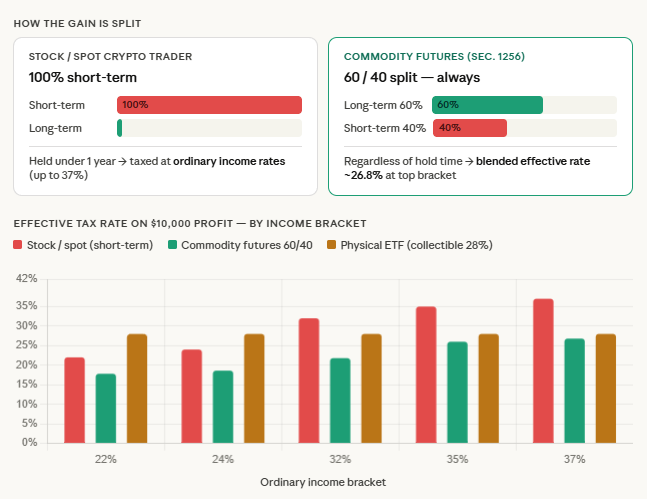
Chad Steingraber spotted the tax angle fast. Right after the classification, he laid out how commodity futures have long operated under a 60/40 rule — the IRS treats 60% of profits as long-term capital gains and 40% as short-term, always, no matter how briefly the position was open.
The tax system treats commodities as capital assets, and that framing carries real weight. Equity investors don’t get this. Someone who buys and sells a stock within a year pays ordinary income rates on every dollar of profit. Commodity futures traders have been avoiding that outcome for years. XRP, now classified as a digital commodity, sits in the same category.
Source: Watcher.Guru
ETFs, ETNs, and the 28% Collectible Rate
For investors using structured products, digital asset taxation gets more complicated. ETFs holding commodity futures generally follow the 60/40 rule and report income through K-1 partnership filings — which, for commodity futures crypto investors, is a decent outcome. ETFs holding the physical asset, though, the IRS taxes as collectibles, pushing the maximum long-term capital gains rate up to around 28%. That sits notably above the standard 15–20% most equity investors pay, and brokers don’t always flag the difference when they pitch these products.
ETNs work differently still — they function as debt instruments, so the IRS taxes short-term gains as ordinary income, while long-term gains may qualify for capital gains treatment. Steingraber flagged these distinctions when he walked through how different vehicles shape digital asset taxation — and the XRP commodity tax outcome genuinely differs across each one, enough that picking the wrong structure carries a real tax cost.
Mark-to-Market, Loss Rules, and What’s Still Unsettled
Steingraber also flagged mark-to-market accounting as something XRP traders could run into under commodity frameworks. Under this rule, traders must report unrealized gains and losses at year-end, even if they sold nothing. For holders who normally defer their XRP commodity tax bill until an actual sale, that’s a meaningful shift in how they manage annual exposure. On the other side, capital losses offset capital gains, and investors can apply up to $3,000 of remaining losses against ordinary income each year. Unused losses carry forward indefinitely — and for XRP investors who rode out significant drawdowns, that tool becomes more valuable as the asset recovers.
At the time of writing, the IRS has not issued formal guidance on how the commodity framework applies to XRP spot holdings and derivatives. The direction, though, is clear — XRP commodity tax rules are moving into territory that historically favored active futures traders, and the 60/40 tax rule crypto investors can access through derivatives is a real, documented advantage. How the IRS will ultimately treat each structure remains an open question, and a tax professional who tracks this space closely is, right now, the most practical next step.
Credit: Source link