
Why Most Trading Platforms Don’t Teach You How to Trade
Image Source
A trading platform can give you charts, prices, indicators, order buttons, account history, and access to the market. What it usually cannot give you is the judgement to decide whether a trade is worth taking.
That is where many beginners struggle. They open a forex trading platform, see professional-looking tools, and assume the platform will teach them as they go. But access is not education. A platform helps you execute decisions. It does not automatically help you make better ones.
The Illusion of Learning Through Trading Platforms
Many beginners confuse platform use with trading skill. Charts, indicators, demo accounts, news feeds, and tutorials can make the interface feel educational, but most features only show information. They do not teach market context, risk control, emotional discipline, or strategy.
- Why beginners expect platforms to teach them: Modern apps are designed to feel simple, and onboarding often makes trading look like a few clicks. That can create the impression that the platform will also teach the decision-making behind each trade.
- Why “tool = skill” is the wrong assumption: A platform may show EUR/USD moving, but it cannot tell a new trader whether the move is meaningful, whether the entry is late, or whether the position size is too aggressive. A good platform can make trading smoother, but it does not create skill.
This is where structured learning matters. Resources such as TFXC help traders focus on strategy, risk management, and decision-making rather than assuming the platform itself will teach them how to trade.
What Trading Platforms Are Actually Built For
Most forex trading platforms are built for access and execution. They connect traders to prices, brokers, charts, order types, and account tools. Forex itself is connected to real cross-border financial activity, and the UK’s balance of payments data gives useful context on the international flows behind currency markets.
In practical terms, a platform helps you:
- place trades;
- set stop-loss and take-profit levels;
- add indicators;
- monitor open positions;
- review account history.
That is useful, but it is not the same as education. If a trader does not know why they are entering, where the trade becomes invalid, or how much they can afford to lose, faster access only makes poor decisions happen faster.
Trading platforms and brokers may earn money through spreads, commissions, financing charges, or related account activity. The UK’s digital strategy gives a wider context on how digital platforms and financial technology have become part of modern economic life. Easier access can be useful, but it does not remove the need for education.
Why This Model Fails Beginners
The model fails beginners because it gives them access before understanding. A new trader can open an account, load a chart, add indicators, and place a trade within minutes. That speed feels empowering, but it also increases the chance of acting before learning.
What usually goes wrong:
- Access comes before understanding: beginners learn buttons before concepts like lot size, leverage, stop-loss, and position risk.
- Tools create overconfidence: more indicators can make weak decisions feel justified instead of improving judgement.
- Losses happen without feedback: the platform records the result, but it does not explain whether the mistake was entry, risk, timing, or trade selection.
The Gap Between “Using a Platform” and “Knowing How to Trade”
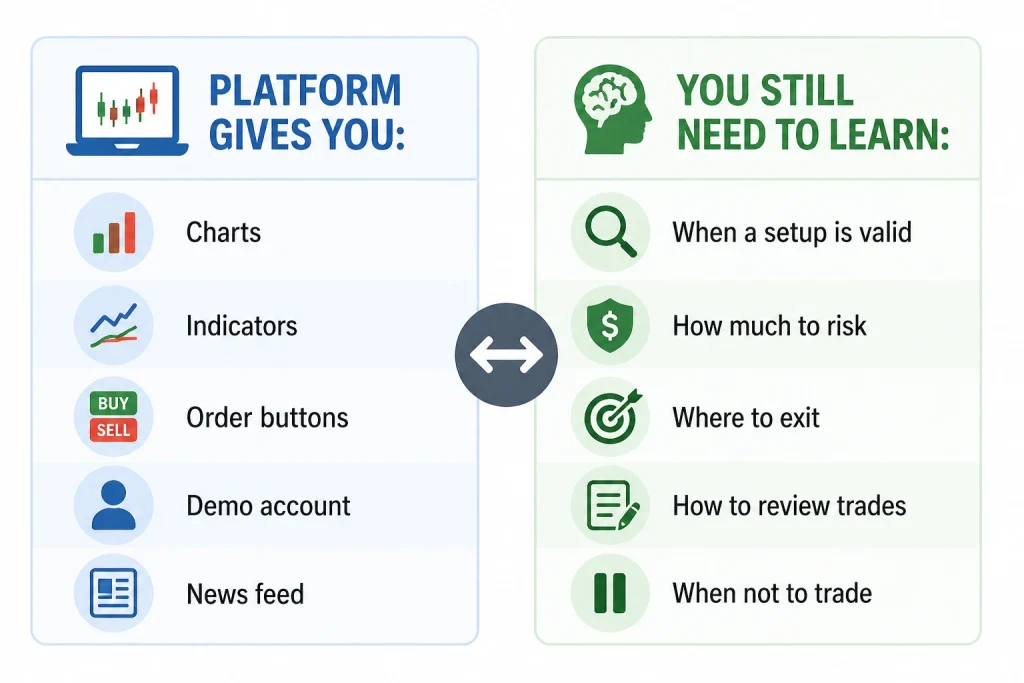
Using a platform is mechanical. Knowing how to trade is analytical. A platform can show price movement, indicators, and news, but it cannot decide what matters most in the moment. That judgement belongs to the trader.
A sudden price spike may be a real breakout, a reaction to news, or a false move before reversal. A beginner often sees movement and thinks, “I should enter.” A better trader asks whether the setup fits the plan, whether the entry is still valid, and where the risk is defined.
Indicators can support a strategy, but they are not a strategy by themselves. A moving average, RSI, or MACD signal only becomes useful when the trader already knows when to enter, where to exit, how much to risk, and when to stay out. Execution should be the final step, not the starting point.
Why More Features Don’t Make You a Better Trader
More features can make a platform look more professional, but they do not automatically improve decision-making.
Common problems include:
- chart overload, where too many indicators hide the actual setup;
- indicator dependency, where traders wait for tools to make decisions for them;
- false control, where visible price, margin, and profit/loss figures feel like risk management but are not.
Real control comes from position size, stop-loss placement, trade selection, and the discipline to stay out when conditions are poor.
What Traders Actually Need (But Platforms Don’t Provide)
Most platforms give access to tools, but not a complete learning path. Beginners are often left to build their education from videos, forums, signal groups, social media, and trial and error. The OECD’s work on financial education and consumer protection supports the broader point that people need financial capability, not just access to financial products.
What traders need instead:
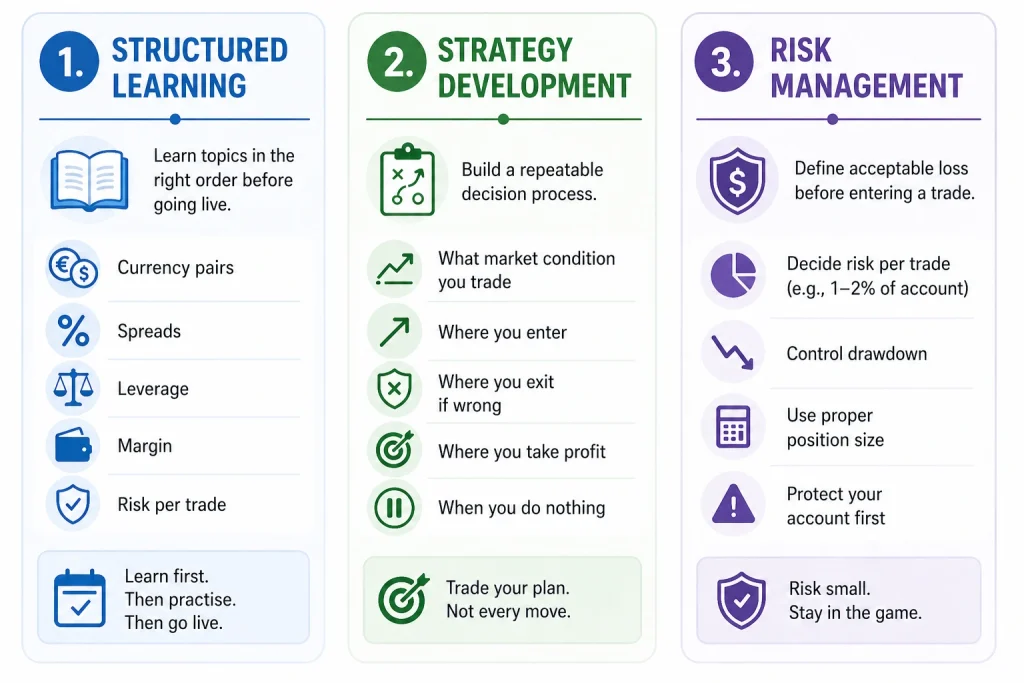
A stronger learning path starts with the basics, then moves into repeatable strategy and controlled risk. That means learning the market before going live, trading a plan rather than every price move, and defining acceptable loss before entering a trade.
How Professional Traders Actually Learn
Professional traders do not become consistent because their platform has more buttons. They improve through structured practice, feedback, repetition, and review. The platform is only where the trade happens. The learning happens before and after execution.
- Mentorship / Systems: Good traders usually learn inside a system: a defined method, a review process, or guidance from someone more experienced. That does not mean copying blindly. It means learning how decisions are made.
- Practice + Review: Practice without review repeats the same mistakes. Review without practice stays theory. Traders need both. A simple routine works best: plan the trade, execute it, record the reason, review the result, and adjust.
- Process Over Tools: Professional traders use platforms for execution, not direction. They choose tools that work reliably, then focus on decision quality. Anyone asking how to learn forex trading should start with the process, not the software.
How to Use Trading Platforms the Right Way
The right platform matters, but it should be chosen for function, not fantasy. A forex trading online platform should make execution clear, pricing transparent, and risk controls easy to use.
Use the platform for execution: clear charts, accurate orders, stop management, trade history, and stable pricing. Use a separate learning process for education: demo practice, a written plan, review, and gradual live risk.
When comparing trading platforms for forex, look for stability, order controls, spreads, usability, and withdrawal reliability. Do not choose based only on “top 10 forex trading platforms” lists.
Final Insight – Platforms Don’t Teach, Systems Do
Most platforms do what they are built to do: provide access, charts, prices, and execution. Searching for the best forex trading platform for beginners may help with usability, but it will not teach patience, strategy, or risk control. A platform helps you place the trade. A system teaches you whether the trade should be placed at all.
Credit: Source link