
Bitcoin’s selloff is creating the short-heavy setup that could reverse it fast
Bitcoin is enduring a multi-front assault on its spot market liquidity as exchange-traded funds, short-term speculators, and cryptocurrency miners simultaneously distribute assets.
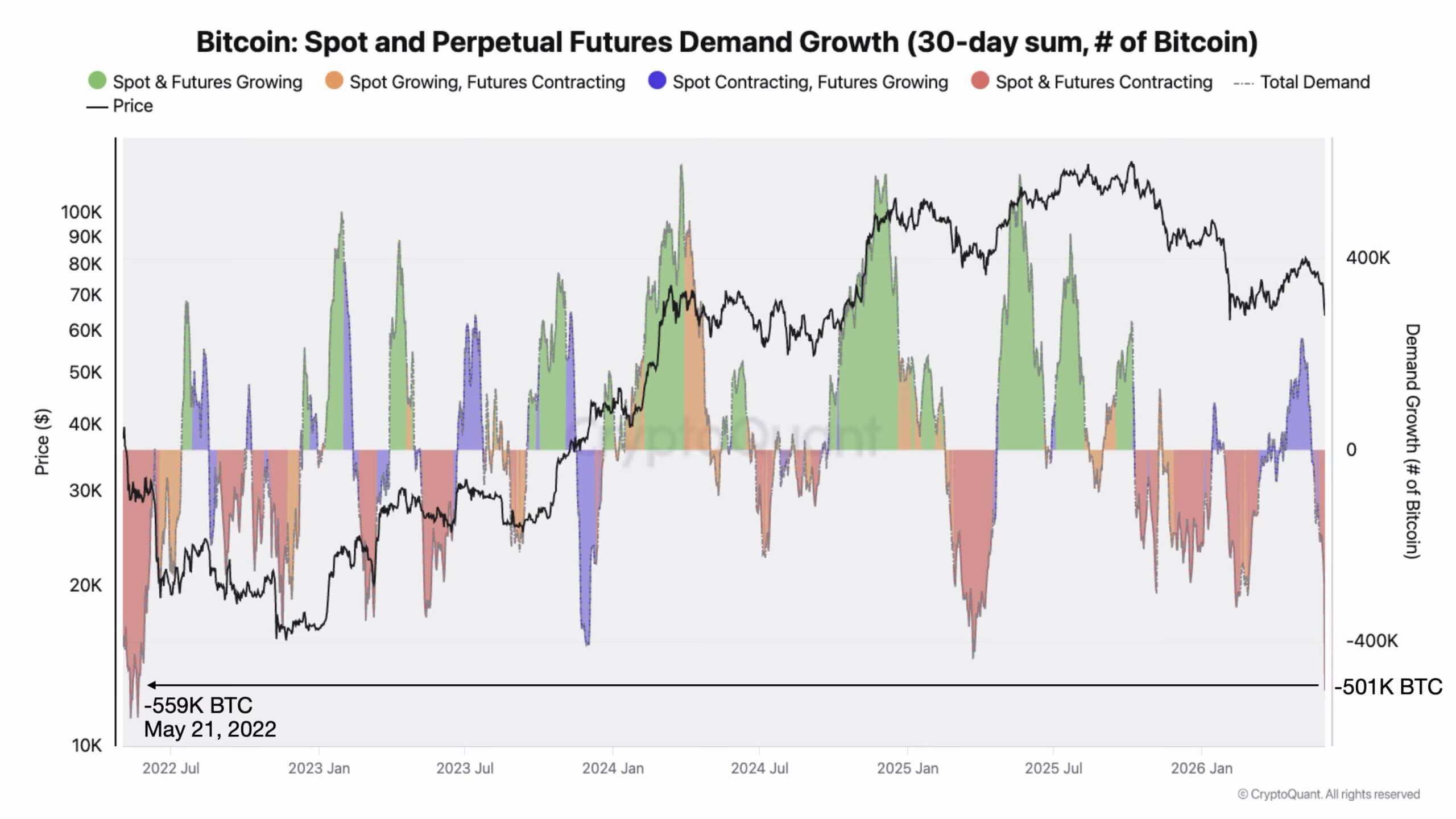
This coordinated selling pressure has drained market demand at the fastest pace since the 2022 collapse of the Terra/Luna ecosystem.
As a result, BTC’s price has tanked 12% over the past week, pushing the top crypto towards the $60,000 level amid heavy hedging activities from market traders. BTC is exchanging hands at $64,036 as of press time, according to CryptoSlate’s data.
Yet, this spot-market flush has created a structural paradox that could still catapult BTC’s value.
The volume of selling has twisted the derivatives market into an increasingly lopsided shape where a record wall of short positions now anchors the market.
However, while traditional spot indicators point downward, any pause in selling could spark a mechanical short squeeze and turn the traders betting against Bitcoin into the forced buyers who fuel its next rally.
Bitcoin ETF exodus runs after the AI trade
The primary driver behind Bitcoin’s recent price weakness is a sharp reversal in institutional capital flows. Spot Bitcoin ETFs recently logged a 13-day streak of consecutive liquidations between mid-May and early June.
According to Galaxy Research, these funds shed 59,351 BTC, pulling roughly $4.33 billion out of the market.
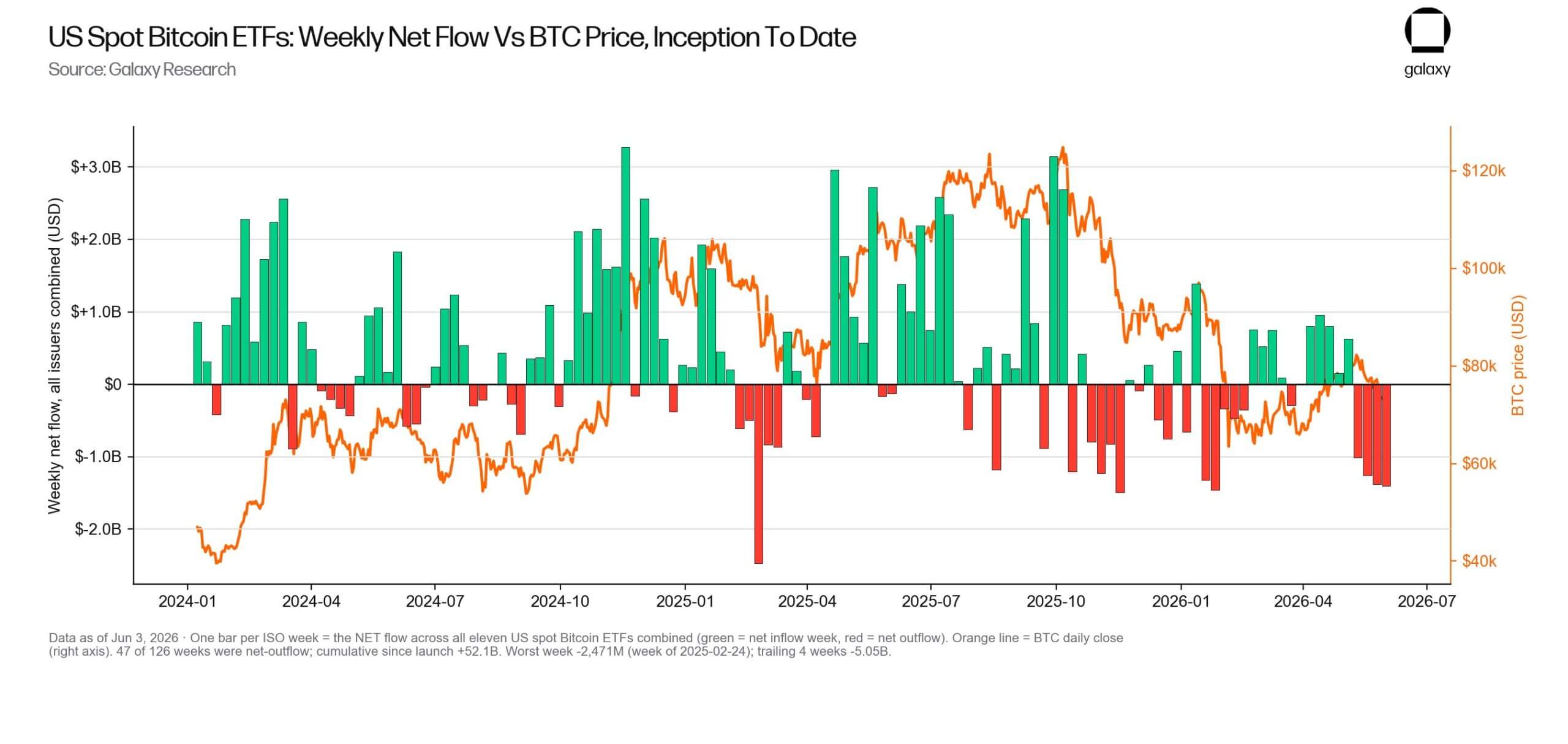
Over a seven-day window, the funds lost $2.78 billion, representing the worst such outflow on record for Bitcoin. The bleeding continued over a 10-day window with $3.06 billion in outflows. The 14-day window saw $4.21 billion exit the market, while the 20-day trailing window recorded $5.42 billion in outflows, shedding 73,080 BTC.
Galaxy Research noted this 20-day period is the single largest outflow window by both dollar value and total Bitcoin volume on record.
Industry executives view this as a macroeconomic realignment rather than an internal failure of the digital asset class. Traditional capital markets are currently routing approximately $400 billion into artificial intelligence infrastructure over a six-month window.
Michael Saylor, chairman of Strategy, said:
“This is a capital rotation, not a Bitcoin impairment. Capital markets are funding the AI buildout at historic scale. Volatility creates opportunity.”
Jeff Park, an advisor at Bitwise, echoed this sentiment. He suggested traders are tapping their Bitcoin allocations to fund the market’s upcoming “hot ball of money” trades, shifting liquidity to chase tech firms like SpaceX and Anthropic.
Moving forward, Park noted, this correlation breakdown will itself become the fuel for future market moves.
Speculative panic and miner capitulation
As institutional support softened, retail and short-term holders entered a phase of outright capitulation.
CryptoQuant data shows that overall Bitcoin demand, which is a combination of the speculative and spot market purchasing, contracted by 501,000 BTC over the past month.
At the same time, short-term BTC holders are driving the most concentrated loss-driven transfers of the year.
Over a 24-hour window, these holders moved 53,800 BTC directly onto exchanges. CryptoQuant researchers highlighted the critical split: 100% of these coins moved while at a loss, while profit-side inflows collapsed to zero.
This means that these underwater buyers are choosing to liquidate their positions directly into market weakness rather than wait out the volatility.
Historically, CryptoQuant noted, peaks in loss-driven inflows from short-term holders cluster around local capitulation events. They mark weak hands, flushing out, and supply transferring from over-leveraged late entrants to higher-conviction holders.
Adding to the overhead supply, BTC miners are also moving coins. CryptoQuant noted that on June 2, Bitcoin miner inflows to the Binance exchange spiked to 24,716 BTC, surpassing a previous February peak by 6.8%.
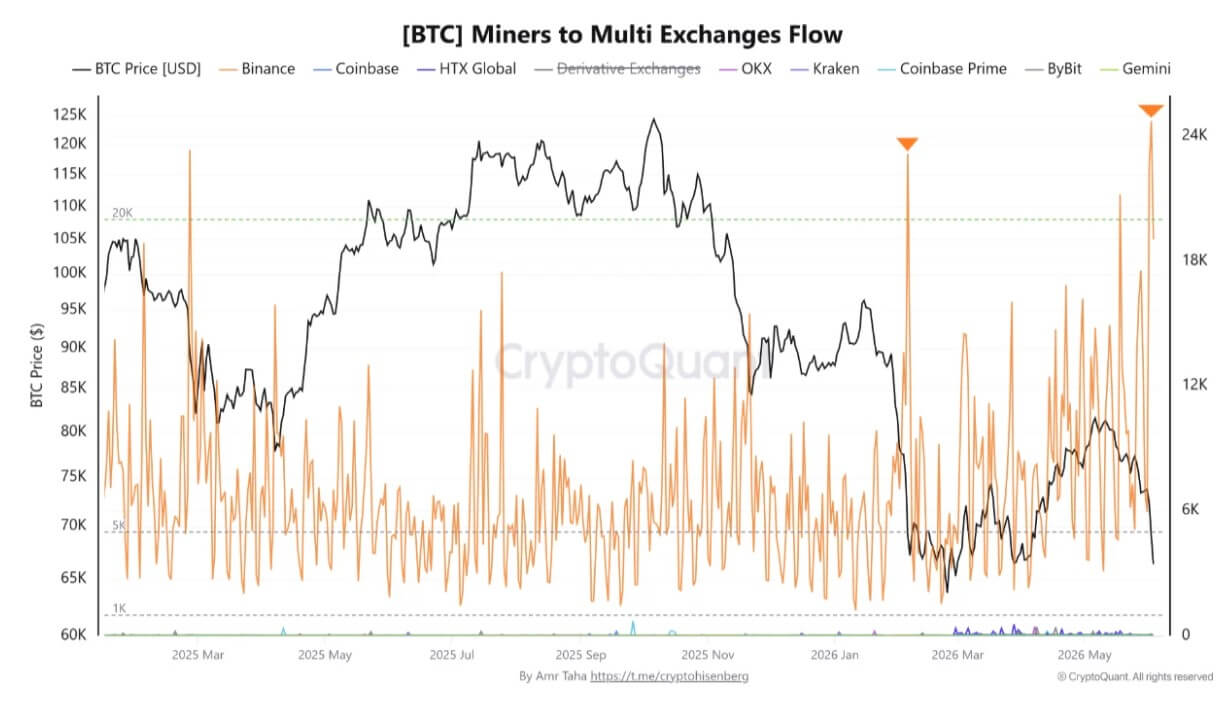
CryptoQuant researchers pointed out that large miner inflows do not confirm immediate, open-market selling. Miners frequently move coins for strategic purposes, including hedging, liquidity management, or internal treasury rebalancing.
However, concentrating this volume of Bitcoin on a single exchange means miner-held supply has moved directly adjacent to market liquidity.
If these inflows remain elevated in the coming days, traders may interpret the data as a sign of renewed miner distribution.
The supply absorption puzzle
This relentless selling creates a structural puzzle when contrasted with long-term accumulation data. While short-term speculators flee, veteran investors are aggressively absorbing the overhead supply.
Brian HoonJong Paik, CEO of the Bitcoin-focused firm Smash Fi, pointed out that long-term holders added 200,000 BTC to their wallets this month and now control 16.3 million BTC, which is sitting near their all-time high holdings.
Paik said:
“The people who have held Bitcoin the longest are not selling into this weakness. They are buying your panic.”
Yet, the sheer volume of coins hitting the market indicates a massive change of hands.
CryptoQuant CEO Ki Young Ju noted that historically, bear markets conclude only after the spot price falls below the realized price. This metric places the current average investor cost basis around $53,000.
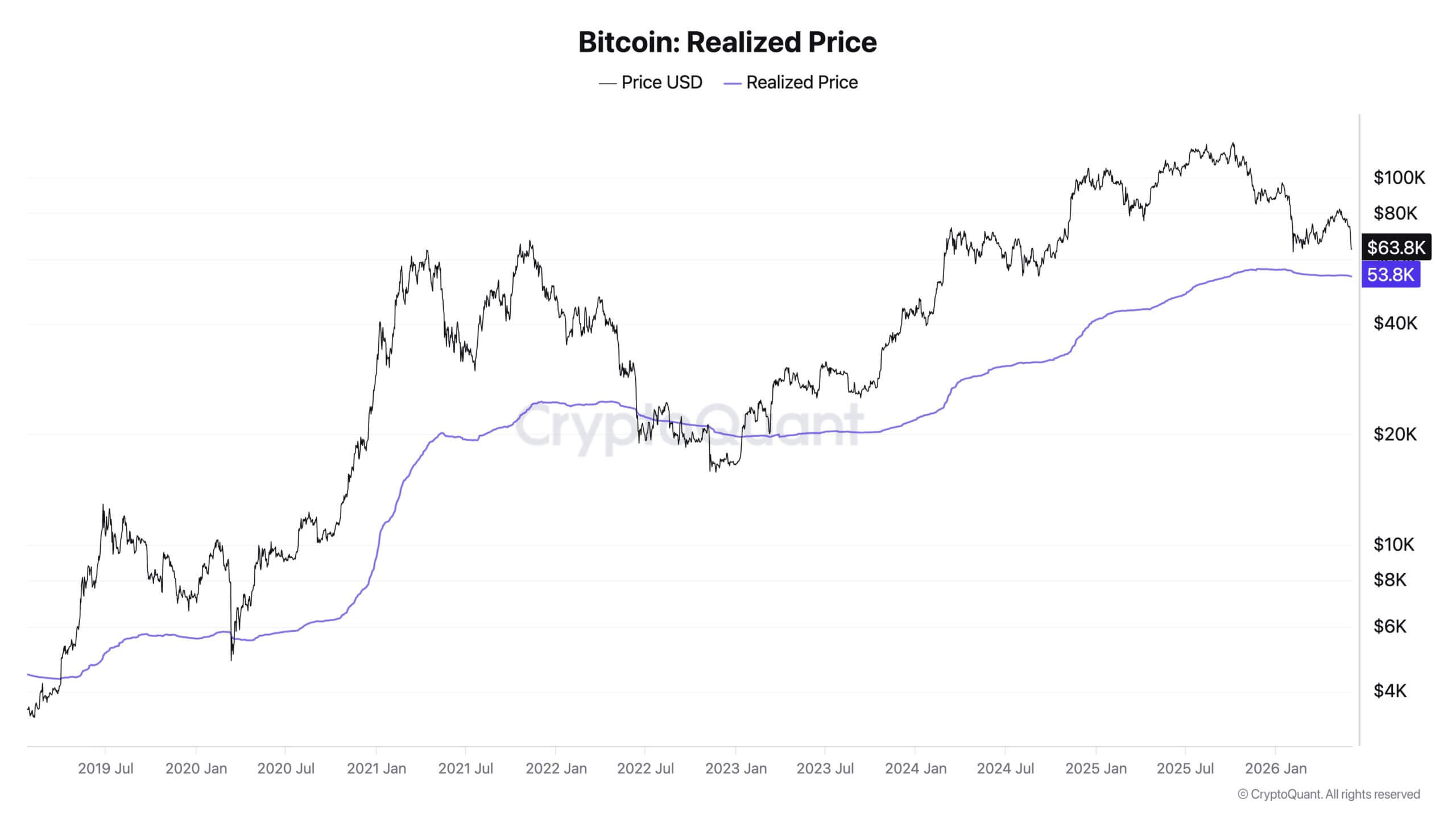
Reaching that level, however, should theoretically prove difficult given the wall of institutional capital that has entered the market.
Ki Young Ju broke down the math to illustrate the scale of this absorption: Since January 2023, Strategy (formerly MicroStrategy) bought 711,206 BTC and sold only 32, effectively locking up 711,174 coins.
Furthermore, since Bitcoin traded at $63,000 in March 2024, spot ETFs absorbed an additional 509,102 BTC, while Strategy acquired another 650,706 BTC.
In total, institutions swallowed 1,240,808 BTC, yet the spot price remains anchored at the same level.
For context, total global exchange reserves hover around 2.7 million BTC, and Satoshi Nakamoto’s estimated holdings equal roughly 1 million BTC.
Despite the market absorbing a supply shock larger than Satoshi’s entire stack, the price remains suppressed.
This dynamic highlights that while traditional long-term holders and institutions accumulate heavily, an unusually motivated cohort of sellers continues to cap any upward momentum.
BTC’s coiled spring set-up
While the spot market paints a picture of exhaustion, the derivatives market has transformed into a coiled spring. The rush to short Bitcoin during this slide has created a top-heavy leverage structure.
Data from analytics firm Alphractal shows a dramatic 72-hour shift in the global liquidation map. On the first day of the flush, the market sat at 66% short-heavy.
By day two, it reached 76%. By day three, the market shifted to an extreme 89% short bias. The metric now pits $98.3 billion in short positions against a $12.2 billion long stack.
The short-to-long ratio sits at 8.06x. Because the market has already washed out most leveraged longs, limited downside risk remains on the chart. The downside magnetic level at $61,054 holds just $1.3 billion in long liquidations.
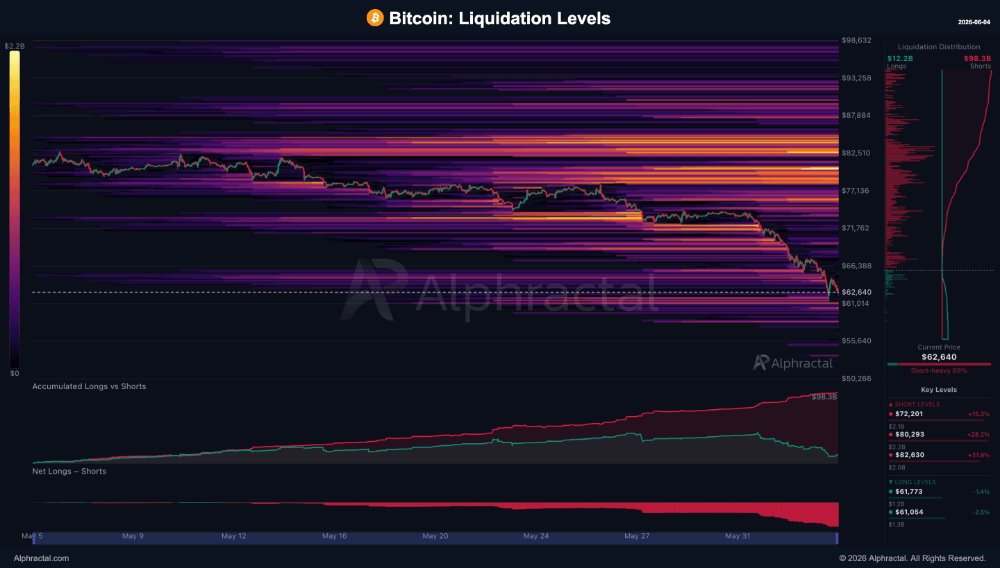
Conversely, the upside is heavily clustered with short liquidation triggers. A modest upward move opens up three waves of forced buying: $2.1 billion at $72,201; another $2.2 billion at $80,293; and a final $2.0 billion layer resting at $82,630.
According to Alphractal, short sellers have stacked more than $6.3 billion in sensitive liquidation triggers between 15% and 32% above the current spot price.
The closest structural analog to this dataset occurred in November 2022, when the same metric printed an 84% short-heavy reading. Over the following 11 sessions, Bitcoin surged approximately 24%.
Bitcoin currently faces undeniable spot pressure from miners, panicked retail traders, and fleeing ETF capital.
However, by over-allocating into bearish trades, the market has set a mechanical trap.
The underlying selling pressure remains real, but the resulting structural imbalance means that the slightest pause in spot distribution could easily trigger a violent, upward cascade powered entirely by the traders betting on Bitcoin’s decline.
Credit: Source link