
Crypto finally has a CLARITY Act date
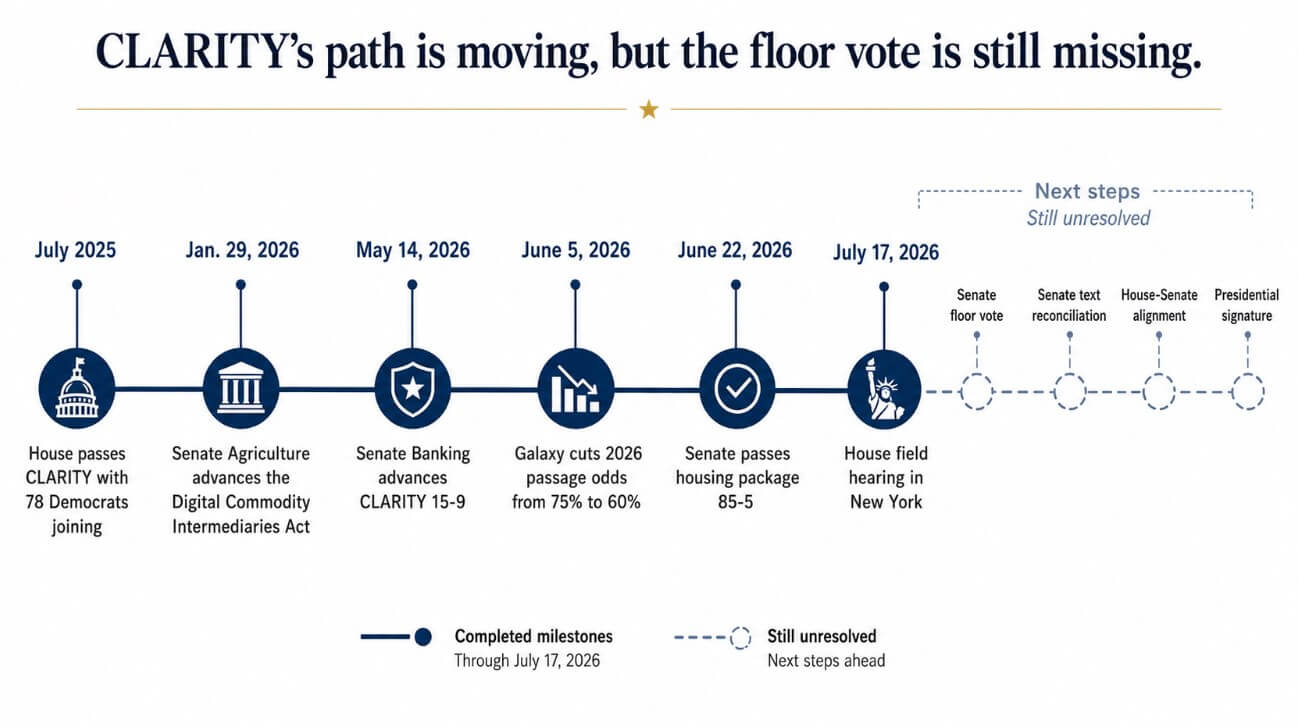
The House Financial Services Committee has scheduled a July 17 field hearing in New York on the CLARITY Act, giving the bill another public stage while the Senate floor vote that would decide its immediate path remains unscheduled.
The CLARITY Act cleared the House in July 2025, with 78 Democrats joining the majority, establishing the baseline that Senate negotiators have worked from ever since.
Senate Agriculture advanced the Digital Commodity Intermediaries Act on Jan. 29, building on the House text and extending new CFTC authority over digital commodity spot markets.
Senate Banking worked through the SEC-facing portion in multiple drafts before a May 14 markup, where the CLARITY Act advanced 15-9.
All 13 Republicans were joined by Democrats Ruben Gallego and Angela Alsobrooks, both of whom immediately conditioned their committee votes on further negotiations before any Senate floor commitment.
What the past six weeks exposed
Between the May 14 markup and the July 17 hearing date, the political picture tightened considerably. Galaxy Research head Alex Thorn cut his 2026 passage estimate from 75% to 60% on June 5, citing the Senate calendar as the primary constraint.
His note identified two compounding factors: the FISA reauthorization fight consumed floor time the week of June 8, compounding a week already lost to the anti-weaponization fund debate, and no visible progress emerged on the ethics and illicit-finance provisions that Democratic crossover votes require.
JPMorgan issued a parallel warning about the narrowing legislative window, and Stifel’s Brian Gardner wrote that a realistic 2026 path requires the bill to clear the Senate by the end of July.
Senator Alsobrooks has stated publicly that she will withhold floor support until a provision covering government officials’ crypto holdings is added, a direct response to the President Donald Trump family’s extensive crypto activity, ranging from stablecoins to memecoins to mining operations.
Democrats also pressed for stronger AML language, and Senator Jack Reed filed roughly 20 amendments before the May 14 markup alone.
The Senate needs at least seven Democratic votes to clear a motion to invoke cloture. Gallego and Alsobrooks are the only Democrats on the committee publicly on record, and both flagged their support as contingent.
Five or more additional Democratic votes are the arithmetic still unresolved heading into the July 17 hearing.
The CLARITY Act stablecoin fight
The bill’s most consequential market-facing dispute centers on Section 404, which prohibits digital asset service providers from paying interest or yield solely for holding a payment stablecoin, while preserving activity-based rewards and incentives tied to transactions, payments, transfers, platform use, loyalty programs, liquidity, collateral, staking, governance, or other ecosystem participation. The provision leaves disclosure rules to joint rulemaking by the SEC and the CFTC.
Six banking trade groups, including the American Bankers Association and the Bank Policy Institute, called the language insufficient at the May 14 vote, warning that stablecoin offerings would draw deposits away from banks and undermine local lending.
Their position is that the passive yield prohibition needs tighter technical language to close perceived loopholes.
The crypto industry largely accepted the Tillis-Alsobrooks compromise text, while banks continued pressing for a stronger standard. That gap led to over 100 amendments being filed before the markup, and no public resolution has emerged since.
Regarding exchanges, stablecoin issuers, and competition between crypto platforms and traditional bank deposits, Section 404 is still open to legislative action.
| Section 404 issue | Crypto industry position | Banking industry concern | Why it matters for markets |
|---|---|---|---|
| Passive stablecoin yield | Accepts ban on deposit-like interest if usage-based rewards remain allowed | Worries loopholes could recreate interest-like products | Affects Coinbase, Circle, USDC rewards, and exchange incentive models |
| Activity-based rewards | Wants flexibility for rewards tied to transactions, usage, or platform activity | Argues the distinction may be too easy to game | Determines whether crypto platforms can compete with bank deposits |
| Deposit competition | Frames stablecoins as payment and settlement infrastructure | Says yield-like rewards could pull deposits from community banks | Links crypto market structure to bank lending and credit availability |
| Regulatory rulemaking | Supports joint SEC, CFTC, and Treasury implementation | Wants tighter statutory language before agencies interpret it | Determines whether Section 404 is settled in law or fought later in rules |
| Political risk | Views compromise as necessary to keep CLARITY moving | Continues pressing senators for stronger language | Keeps the bill exposed to amendments before a floor vote |
The housing connection
The Senate Banking Committee’s CLARITY draft initially included the Build Now Act as Section 904, a housing-supply incentive provision unrelated to digital assets, added as political packaging around the bill.
Congress then moved the 21st Century ROAD to Housing Act separately: the Senate approved the package 85-5 on June 22, and the House gave final approval on June 23, sending it to Trump’s desk. Tim Scott chaired the committee that drove both pieces of legislation.
Therefore, the housing scaffolding no longer needs to ride inside CLARITY. It also showed that the Senate Banking Committee can still secure bipartisan majorities on mainstream financial policy even as digital-asset negotiations remain unresolved.

The CLARITY Act floor test
A 15-9 committee vote is real momentum toward a much harder standard, since the bill now requires 60 votes, Republicans hold roughly 53 seats, and the two Democrats who voted yes in committee have both publicly conditioned their floor support on further negotiation.
Senator Cynthia Lummis has described an August recess floor vote as more realistic and warned that a 2026 failure would push the next viable legislative opening to 2030.
The bull case is that the July 17 hearing gives industry and Republican leadership a fresh public stage in New York’s financial center, Democratic holdouts secure enough movement on ethics and AML language to commit to floor votes, and the Senate clears cloture before the August recess, with a presidential signature arriving in August.
That outcome would compress the legal-risk premium on exchanges, stablecoin issuers, and token networks still caught between SEC and CFTC jurisdiction.
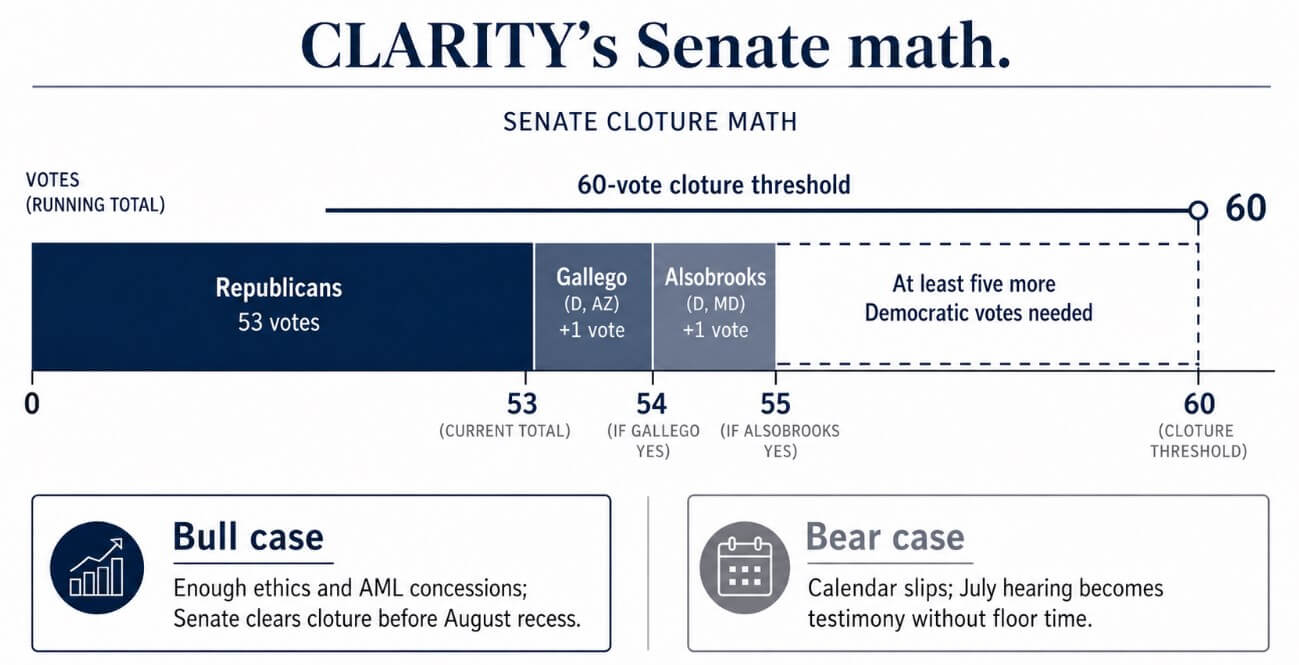
The bear case is that the Senate calendar beats the bill before the recess, the July 17 hearing adds public testimony to a bill still awaiting floor time, and CLARITY enters a fall schedule running straight into midterm campaigning.
Gardner’s warning was specific: missing the recess would see the bill’s prospects “deteriorate materially.”
Exchanges and altcoins would carry market structure-related uncertainty as a sustained risk premium, while the EU’s MiCA framework and Hong Kong’s stablecoin licensing regime continue to set the international standard.
Seven Democratic votes are the variable that determines whether CLARITY becomes law in 2026 or becomes a record of legislative momentum that ran out of time on the Senate floor. The July 17 hearing matters only if it changes that count.
Credit: Source link