
Bitcoin’s $60K rebound just collapsed as $427M in long liquidations followed sticky inflation data
Bitcoin’s rebound above $60,000 just failed because the bundle of U.S. macro data released June 25 gave risk traders the opposite of clean relief: sticky inflation, firm demand, a stronger growth revision, fewer jobless claims, and resilient ex-transport orders.
Bitcoin briefly flash-crashed in a liquidation-driven flush, falling from an intraday high near $61,844 to a low of about $58,189 before recovering part of the move, trading around $59,630. The rebound leaves BTC off the intraday lows as of press time, but the price remains below the pre-drop range.
The move coincided with a heavily one-sided liquidation event. CoinGlass liquidation readouts showed about $482 million in crypto liquidations over one hour, with roughly $427 million coming from longs and only about $54 million from shorts, while BTC accounted for about $272 million of the total.
The equity move was also sharp but partially retraced. SPY dropped from the high-$730s into the $728 to $730 area before rebounding to $737 on the latest 30-minute candle. That candle showed an open at $735, a high at $737, a low at $734, and a close at $737, while the chart label still showed SPY down about 1.30%.
DXY reversed lower after trading up toward the 101.8 area, falling back to 101.376 on the latest print. The U.S. 10-year yield also dropped hard, moving from the upper-4.4% area to around 4.374%, leaving rates near the lower end of the displayed range after the flash move.
The move kept Bitcoin closer to the $58,000 area than to a restored upside range, turning $60,000 from a recovery target into the line buyers still had to prove.

The rejection was more than another chart-level failure. The release arrived after Bitcoin had already slipped below $60,000, then denied traders the soft-data narrative that could have helped risk assets rebound.
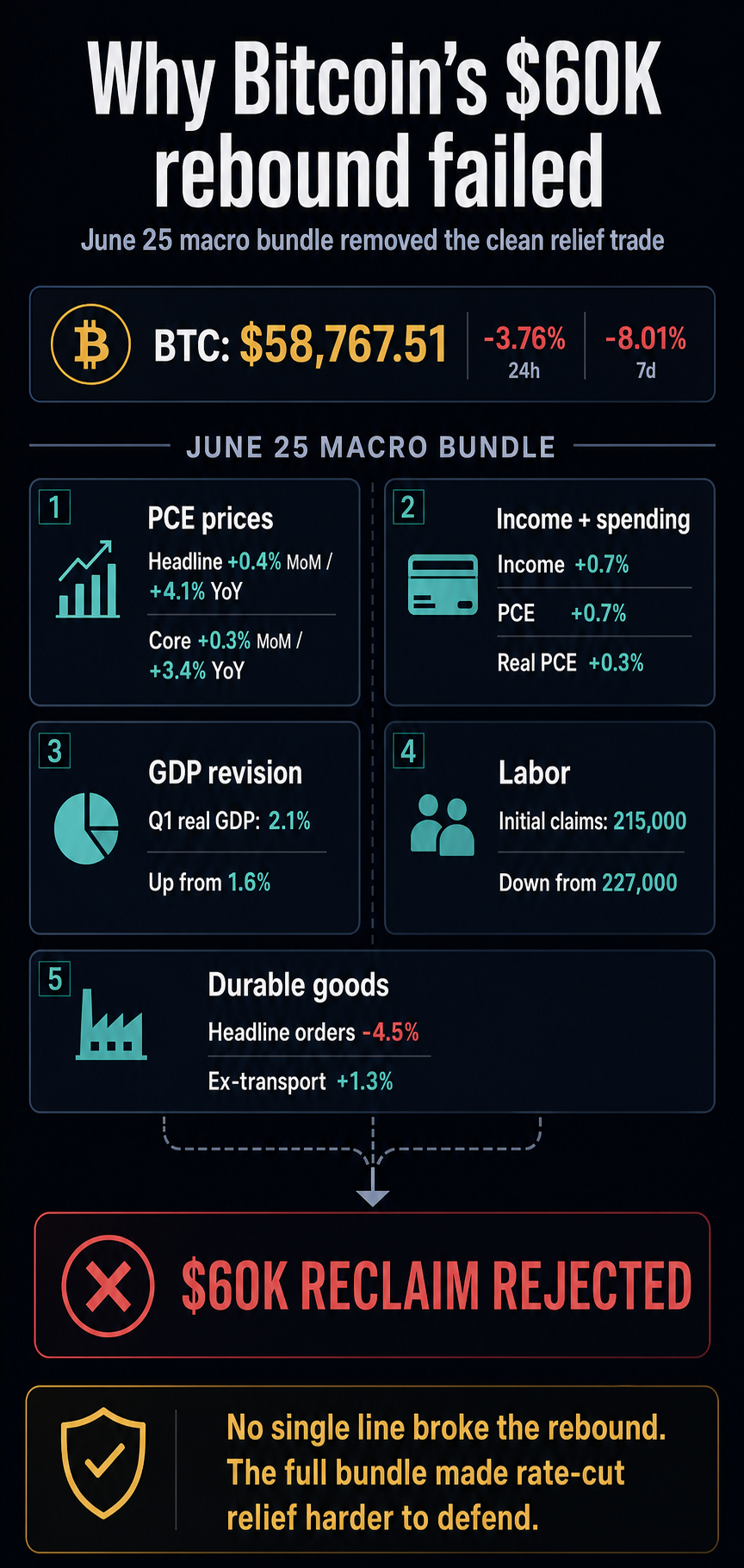
The June 25 releases showed sticky price pressure, high income and spending, a firmer growth revision, fewer jobless claims, and an orders report whose weak headline was softened by a stronger ex-transport reading.
The data undercut the relief trade
The most direct pressure came from the May personal income and outlays release. BEA said personal income rose 0.7%, disposable personal income rose 0.7%, PCE rose 0.7%, and real PCE rose 0.3%.
Prices also stayed elevated. The headline PCE price index rose 0.4% month over month and 4.1% year over year, while core PCE rose 0.3% month over month and 3.4% year over year.
That combination gave the market a difficult mix. Spending and income were still expanding, while inflation had not cooled enough to make quick policy relief easier to price.
For Bitcoin, that meant the rebound was fighting the same macro headwind that often hits long-duration and high-beta assets first.

The growth data reinforced that message. BEA’s third estimate for first-quarter GDP revised real growth to a 2.1% annualized pace from the second estimate of 1.6%.
A stronger growth revision alongside sticky inflation usually keeps immediate rate relief harder to price.
Labor data added another piece. The Labor Department’s weekly claims report showed initial jobless claims at 215,000 for the week ending June 20, down from the prior week’s revised 227,000.
Lower claims kept the labor-market slowdown argument from carrying the risk-asset rebound.
Durable goods were more mixed, but the detail still leaned against an easy dovish interpretation. The Census Bureau’s advance durable goods report showed May orders down 4.5% as transportation equipment drove the decrease.
Orders excluding transportation rose 1.3%, which made the underlying signal more resilient than the headline decline suggested.
| Data point | Latest reading | Why it pressed risk assets |
|---|---|---|
| May PCE prices | Headline +0.4% monthly, +4.1% yearly; core +0.3% monthly, +3.4% yearly | Inflation stayed too sticky for a clean relief trade |
| Income and spending | Personal income +0.7%; PCE +0.7%; real PCE +0.3% | Demand looked firm rather than clearly slowing |
| Q1 real GDP | Revised to +2.1% annualized from +1.6% | Growth looked stronger than the prior estimate |
| Jobless claims and durable goods | Claims fell to 215,000; ex-transport durable goods orders rose 1.3% | Labor and orders detail limited the slowdown argument |
Bitcoin became the high-beta expression
The market reaction required a smaller catalyst than a uniform downside surprise would have. The full bundle only had to weaken the idea that U.S. data had softened enough to pull policy expectations lower.
That is why the failed reclaim near $60,000 was different from a standalone support test. Bitcoin was already fragile after its latest slide, and the macro release arrived at the moment buyers needed a reason to defend the rebound.
The data indicated an economy that still had sufficient demand and labor strength to keep inflationary pressures relevant.
CryptoSlate’s Bitcoin data showed how far the asset had already moved. BTC’s 8.01% seven-day decline and $48 billion in 24-hour volume pointed to heavy trading around the break.
The $60,000 level had become both a confidence test and a round number.
The market also entered the release with other crypto-specific stress points already in view. Recent CryptoSlate coverage had mapped liquidation risk near the $57,300 area, ETF-flow pressure around the $58,000 zone, and the possibility that Bitcoin’s PCE reaction could collide with quarterly options expiry.

Those factors can intensify a move once the price starts to slide, while the macro release provided the broader reason the rebound lost support.
Bitcoin’s next attempt at $60,000 now looks tied to broader liquidity conditions rather than only to crypto-native dip buying.
If risk assets stabilize after absorbing the June 25 releases, BTC can treat the data shock as another failed downside push and try to rebuild above the reclaim line.
That path would require the market to stop treating strong activity data and sticky inflation as a fresh reason to keep pressure on high-beta assets.
If the dollar and rate-sensitive parts of the market continue to weigh on risk, the $58,000 area remains exposed. That would keep liquidation-zone and ETF-flow pressure relevant as accelerants, especially with options expiry close enough to affect positioning.
The next signal is bigger than crypto-native dip buying. Bitcoin needs the macro backdrop to stop fighting the rebound before buyers can turn $60,000 back into support.
Credit: Source link