
Ethereum’s oldest wallets are selling into the $1,500 demand line buyers cannot dodge
Four long-dormant Ethereum wallets have turned ETH’s latest drawdown into a cleaner test of buyer conviction.
The wallets received 37,602 ETH about eight years ago and have remained quiet amid much larger unrealized gains. They have now moved 33,623 ETH, worth roughly $52.5 million, according to Lookonchain, at an average price of around $1,560. ETH was trading near $1,575 at the time.
The sale puts a sharper edge on Ethereum’s weakness. Long-term holders who sat through prior bull-market exits are now supplying the market at levels well below peak-cycle prices, which shifts the question from whale behavior to absorption. ETH’s next recovery needs spot demand strong enough to take down old supply without turning every rebound into liquidity for dormant wallets.

Old supply changes the signal
Large transfers from dormant Ethereum wallets carry a different message than routine market-maker inventory or leveraged liquidations. The relevant detail is the patience embedded in the coins. These addresses had the chance to sell into stronger ETH cycles, yet the selling began as the asset tested a much lower zone.
That makes the $1,500 area less of a simple price level and more of a conviction floor. A market can absorb old coins when new demand is expanding, but the same supply becomes heavier when buyers are hesitant, ETF flows are negative, and competing layer-1 narratives are taking attention from ETH.
On CryptoSlate’s broader market board, ETH’s recent decline has also looked weak compared to Bitcoin and other large-cap rivals. A roughly $52.5 million sale is small beside global ETH trading volume, but old-holder selling rarely needs to become a flood to affect sentiment. It only has to arrive while marginal buyers are already questioning the recovery setup.

ETF outflows complicate the absorption story
Spot ETH ETFs add another pressure point. US spot ETH funds recorded net outflows from June 22 through June 26, removing one of the cleaner channels for fresh spot demand while the market was already digesting dormant-holder supply.
The ETF channel does not need to explain the wallet sales directly. Its importance is mechanical. If long-held coins move from patient wallets into the market, the recovery depends on who is ready to buy them. Weak ETF demand makes that absorption test harder because it reduces visible institutional intake at the same time ETH is fighting to stabilize.
Rival layer-1 activity keeps that test under pressure. Solana and other competing chains continue to frame themselves around faster consumer and trading activity, while Ethereum has to prove that its liquidity, DeFi depth, and settlement role are still enough to attract fresh capital after a drawdown.

Network depth is the counterweight
Ethereum still has the deepest on-chain base in crypto. DefiLlama data shows Ethereum with about $37.2 billion in DeFi TVL and more than $155 billion in stablecoins on the network, giving ETH a structural support story that most rival chains cannot match.
The problem is that network strength and token demand are related without being identical. DeFi TVL, stablecoin balances, DEX volume, and settlement activity can support the long-term case for Ethereum, but they do not automatically absorb near-term supply from older wallets. For traders, the next signal is whether spot buyers step in when the market knows patient supply is available.
| Signal | Current condition | Market implication |
|---|---|---|
| Dormant wallet sales | 33,623 ETH sold from wallets that received 37,602 ETH eight years ago | Old-holder conviction is weakening at lower prices |
| ETH price pressure | ETH traded near $1,575 after a weak recent stretch | The $1,500 zone is acting as a demand test |
| ETF flows | Spot ETH ETFs saw outflows from June 22 through June 26 | Visible institutional absorption has softened |
| On-chain base | Ethereum still leads DeFi TVL and stablecoin liquidity | Network depth remains the main counterweight to old supply |
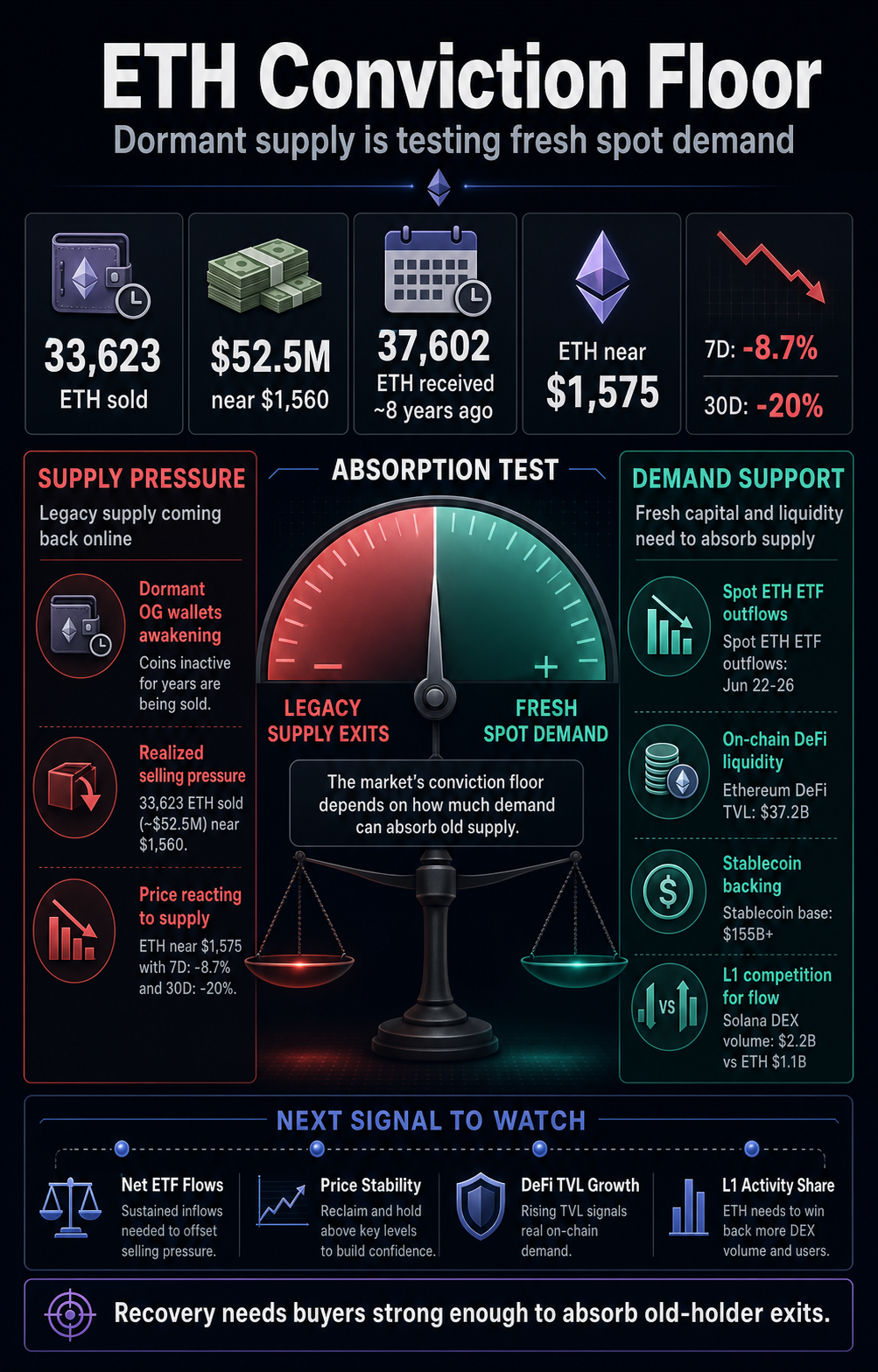
That leaves ETH with a straightforward burden. A rebound that depends only on sellers pausing is fragile. A stronger recovery needs new spot demand, whether from ETFs, direct accumulation, treasury buyers, DeFi users, or broader risk appetite, to absorb coins from holders who waited years before finally exiting.
Until that demand appears, the dormant-wallet sales will remain a live warning. Ethereum’s fundamentals can still support the asset, but the market is now asking whether those fundamentals can translate into buying at the exact moment when some of ETH’s oldest holders have decided to leave.
Credit: Source link