
Ripple gives RLUSD a MiCA foothold in Europe and route into African payments
Ripple is pursuing a coordinated expansion of its stablecoin infrastructure across Europe and Africa, combining a strategic investment in payments company Flutterwave with preliminary regulatory approval in the European Union to widen the reach of its digital-asset services.
The dual-track strategy targets high-volume cross-border payment and remittance corridors in sub-Saharan Africa while giving Ripple a potential regulatory base across the 30-country European Economic Area.
By placing its dollar-pegged RLUSD stablecoin within Flutterwave’s regional payment network, the San Francisco-based company is seeking to move beyond its role as a provider of cross-border payment and liquidity technology and become part of the infrastructure supporting regulated commercial stablecoin flows.
The plan pairs two assets that stablecoin issuers increasingly need to compete: permission to serve financial institutions in major markets and access to payment networks capable of generating regular transaction volume.
Ripple’s proposed crypto-asset service provider license in Luxembourg would provide the regulatory reach. Flutterwave, which processes payments for businesses across Africa, would supply local collection methods, payout channels, and remittance customers.
The approach shows how competition in the stablecoin market is shifting beyond token issuance. The largest providers have established deep liquidity on exchanges, but the next phase of growth is increasingly tied to whether stablecoins can be integrated into payroll, trade, treasury management, and cross-border payments without requiring customers to handle the underlying technology.
Flutterwave gives RLUSD a route into African payments
Ripple participated in Flutterwave’s Series E financing round, which valued the African payments company at $3.2 billion. The companies did not disclose the size of Ripple’s investment.
The partnership calls for Flutterwave to integrate RLUSD, Ripple Payments, and the XRP Ledger (XRPL) into infrastructure that already connects businesses with cards, bank transfers, mobile wallets, and other domestic payment methods.
Flutterwave revealed plans to use RLUSD as a settlement asset within its payment network and Send App remittance service. It also intends to use the XRPL blockchain network to clear transactions and connect its regional infrastructure with Ripple’s international payout network through a common application programming interface.
The arrangement could allow a business to accept or send money through familiar local methods while RLUSD moves between financial intermediaries in the background. That would reduce the need for merchants and consumers to hold cryptocurrency directly.
Flutterwave said its broader stablecoin infrastructure is already operating commercially and being tested within Send App. The integration of RLUSD and Ripple’s other products represents the next stage of that buildout rather than evidence that the entire system is already processing transactions at scale.
Reece Merrick, Ripple’s managing director for the Middle East and Africa, said the investment would place RLUSD within Flutterwave’s infrastructure and direct stablecoin flows through the XRP Ledger. Ripple also plans to make its payment network available for more cross-border transactions in the region.
The companies have not provided a launch timetable, expected transaction volume, or projected savings for customers. They also have not identified the first payment corridors that will use RLUSD or explained how they will manage conversion between the stablecoin and local currencies.
Those details will determine whether blockchain settlement produces lower costs for businesses. Moving tokens across a ledger can take seconds, but the full transaction may still depend on banks, currency dealers, compliance reviews, and sufficient liquidity at the point where digital dollars are converted into local money.
Nigeria shows the demand Ripple is chasing
Ripple’s investment gives it a route into markets where stablecoins are already being used for purposes beyond speculation.
Nigeria received about $59 billion in crypto-asset inflows between July 2023 and June 2024 and has accounted for roughly 60% of stablecoin inflows into sub-Saharan Africa since 2019, the International Monetary Fund (IMF) said.
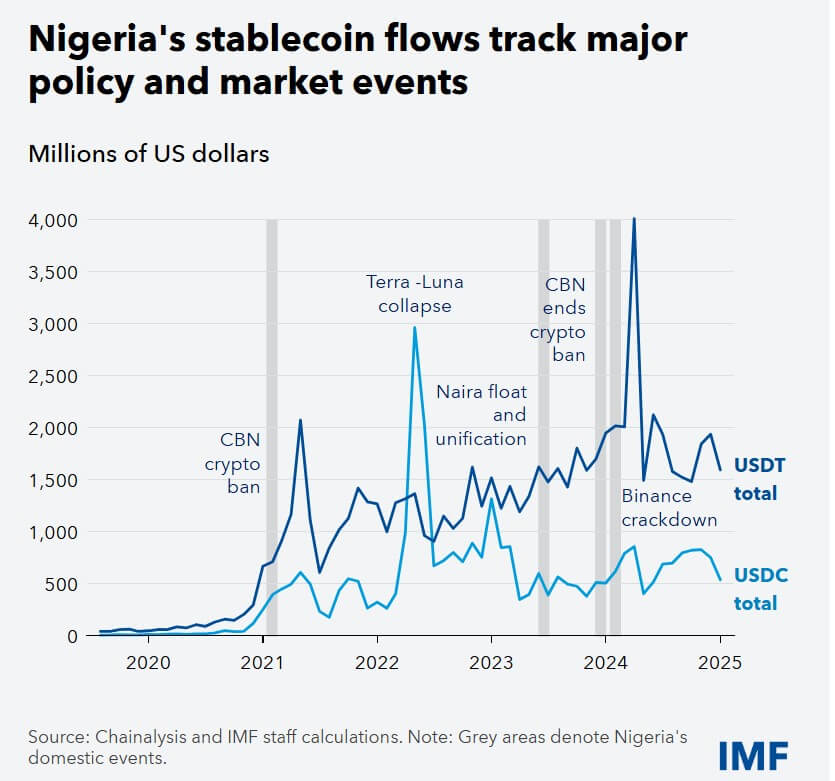
Dollar-linked tokens have become an alternative for households and companies dealing with naira depreciation, inflation, and limited access to foreign exchange. They allow users to store dollar-denominated value, pay overseas suppliers, and receive money from abroad through smartphones and digital wallets.
Stablecoins can also compete with conventional remittance services. Sending $200 to sub-Saharan Africa costs about 9% of the transaction on average, compared with a global average of approximately 6%, the IMF said, citing World Bank data.
The gap creates an opening for companies that can connect blockchain settlement with local payout networks. A stablecoin transfer may move quickly between digital wallets, but it becomes more useful for commerce when recipients can reliably convert it into bank deposits or domestic currency.
That conversion layer is where Flutterwave could prove valuable to Ripple. Its existing relationships with banks, merchants, and payment providers may give RLUSD a distribution channel that would be difficult for Ripple to build independently in each African market.
Meanwhile, this opportunity also carries regulatory risks.
The IMF has warned that widespread use of dollar stablecoins can resemble digital dollarization, reducing demand for domestic currencies and weakening the transmission of monetary policy. Transactions conducted through wallets and offshore platforms can also be harder for authorities to monitor than payments routed through banks.
Ripple and Flutterwave are betting that placing stablecoin transactions inside regulated corporate infrastructure can address some of those concerns.
Even so, the companies will have to comply with different foreign-exchange, payments, and digital-asset rules across the continent rather than relying on a single African regulatory framework.
Luxembourg opens the European side
Ripple’s preliminary approval in Luxembourg addresses the institutional end of the proposed network.
On June 23, the Brad Garlinghouse-led firm announced that the Commission de Surveillance du Secteur Financier issued Ripple a “Green Light Letter” for a crypto-asset service provider license under the European Union’s Markets in Crypto-Assets (MiCA) regulation. The decision remains subject to final conditions and is not yet a full authorization.
Once completed, the license would allow Ripple to provide covered crypto services across the European Economic Area, which includes the EU’s 27 member states as well as Iceland, Liechtenstein, and Norway.
Ripple intends to combine the authorization with its existing Luxembourg electronic money institution license. The company said the two approvals would allow banks, financial technology companies, and corporations to collect, exchange, and distribute fiat money, stablecoins, and other crypto assets through one integration.
That combination is central to Ripple’s strategy. The electronic money license covers parts of the conventional payments system, while the MiCA authorization would govern its provision of crypto-asset services.
Together, they could allow Ripple to link European institutional customers with payment and settlement channels outside the region.
Cassie Craddock, Ripple’s managing director for the UK and Europe, said demand from banks and fintech companies is expanding as financial institutions explore blockchain-based payments, collateral management, and tokenized assets.
Ripple says its payments platform has processed more than $100 billion and operates in more than 60 markets. It also says it holds more than 75 regulatory licenses globally.
The Luxembourg application comes as Europe approaches the end of the maximum transition period for companies operating under earlier national crypto registrations. MiCA requires service providers to obtain authorization from one member state, after which they can use the license to serve customers across the bloc.
The deadline has increased the commercial value of obtaining approval. Binance faces the prospect of losing permission to serve EU customers after its application in Greece was expected to be rejected, Reuters reported, citing people familiar with the process.
Binance said Greek regulators had not formally informed it of a rejection and that it would update users before the June 30 deadline.
Ripple’s preliminary approval does not guarantee that its final license will arrive on a particular date. It nevertheless places the company closer to authorization at a time when some larger crypto businesses are struggling to secure a European regulatory base.
RLUSD’s distribution must still translate into volume
While RLUSD has shown considerable growth since its 2024 launch, it remains much smaller than the stablecoins that dominate global crypto trading.
Its market value stood at about $1.62 billion, with tokens issued on Ethereum and the XRP Ledger, according to DeFiLlama. In comparison, Tether’s USDT, the largest stablecoin by market capitalization, had about $186 billion in circulation, while Circle’s USDC had approximately $74.5 billion.
That difference explains why payment distribution is important to Ripple. RLUSD is unlikely to challenge the leading stablecoins through exchange liquidity alone.
So, embedding it within Flutterwave’s business-payment and remittance infrastructure could create transaction demand tied to commerce rather than trading. At the same time, the Luxembourg license could support the other end of those flows by giving European institutions a regulated way to access Ripple’s payment and stablecoin services.
In theory, a European business could send value through Ripple’s infrastructure while Flutterwave manages collection, conversion, or payout in an African market.
In practice, Ripple still must demonstrate that customers will choose RLUSD over bank deposits, USDT, USDC, or conventional payment networks. It must also ensure that enough liquidity exists to convert RLUSD into local currencies without widening foreign-exchange spreads and erasing the savings promised by faster settlement.
Credit: Source link