
Wall Street is buying XRP while Binance traders keep betting against it


XRP is rising into a market split between traditional finance infrastructure and crypto-native skepticism.
According to CryptoSlate’s data, the token recently traded above $1.46 as spot-market indicators improved, exchange-traded funds drew their strongest daily inflows in more than four months, and Ripple expanded the credit capacity behind its institutional prime brokerage business.
However, this came at a time when derivatives traders continue to lean against the move, with Binance futures data showing persistent selling pressure even as leverage rebuilds across major exchanges.
That tension has turned XRP into a test case for whether institutional access, ledger utility, and market infrastructure can overpower a futures market still positioned for weakness.
Spot demand meets futures resistance
The divide between spot demand and derivatives positioning has become the clearest feature of XRP’s market structure.
US spot XRP ETFs recorded $25.8 million in net inflows on May 11, their largest daily intake since early January, SoSoValue data show.
This extends the four funds’ positive performance this month, attracting more than $60 million in inflows. XRP-focused funds have registered total inflows of over $1.35 billion since their launch last year.
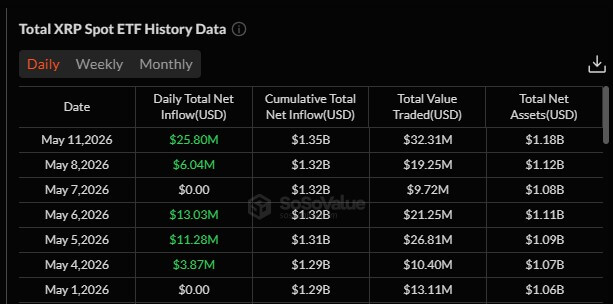
Those inflows give XRP a regulated channel at a time when exchange-based positioning remains conflicted. ETFs allow investors to gain exposure through brokerage accounts and adviser platforms without managing direct custody or trading on crypto exchanges.
That opens the asset to a wider pool of allocators than the offshore derivatives venues that have historically shaped much of XRP’s short-term price action.
However, the mood in the derivatives market is different.
CryptoQuant data show that the Binance perpetual cumulative volume delta has fallen to about -$434 million, even as XRP has pushed higher. Open interest on Binance has climbed from about 207 million XRP on April 30 to nearly 232 million, showing leverage is returning after the latest reset.
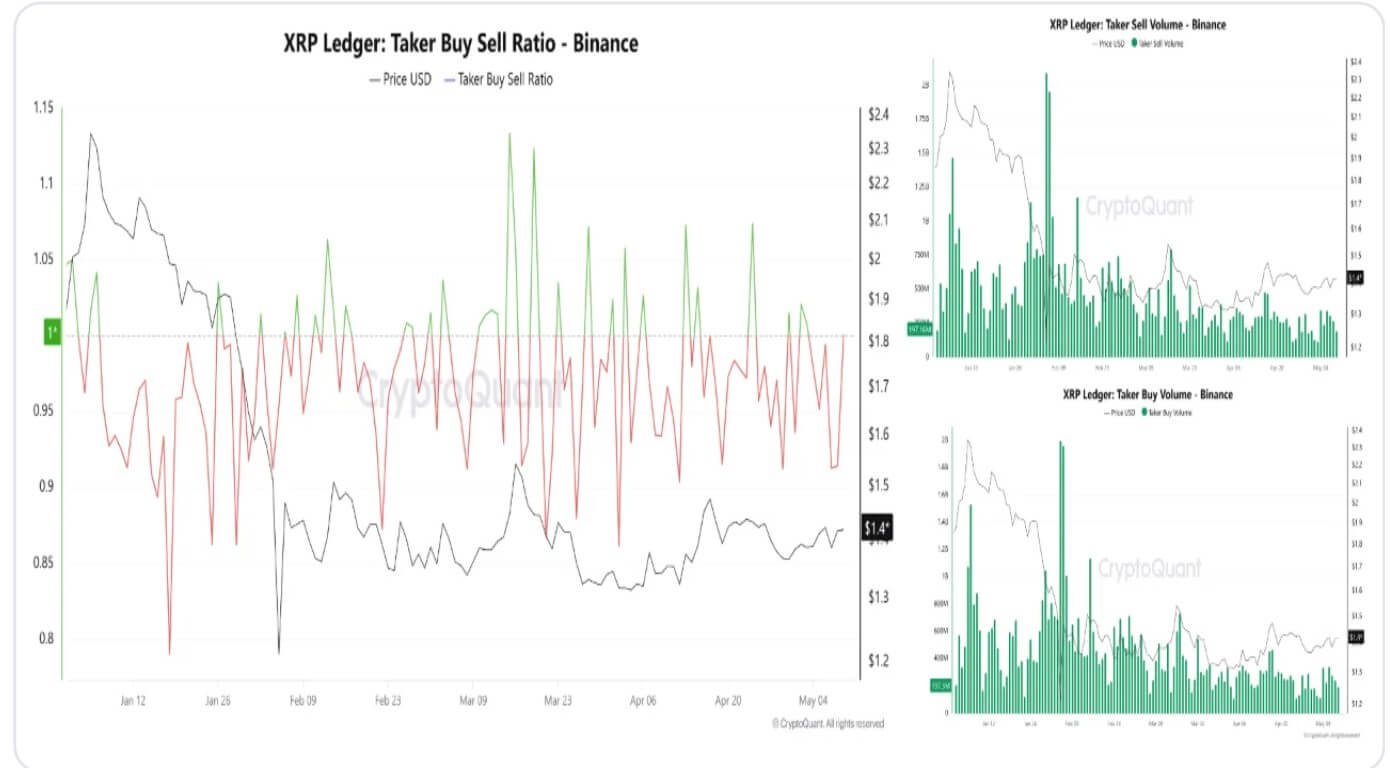
The increase is not limited to Binance. On May 11, open interest rose by about $18 million on Binance, $10.4 million on OKX, and $8.5 million on Bybit, adding almost $36.9 million across the three exchanges.
Ordinarily, rising open interest can confirm a stronger trend when spot demand is also expanding.
However, XRP’s setup is more complicated. Spot estimated cumulative volume delta across centralized exchanges has slipped to about $575 million, even as the token trades higher.
That suggests the rally is not yet being driven by broad, clean spot accumulation.
Notably, XRP funding rates point to the same tension. XRP funding on Binance has carried a bearish bias for nearly three months, CryptoQuant data show, even as the token has gained roughly 27% over the same period.
This negative funding means shorts are paying longs to keep bearish exposure open.
Ripple adds Wall Street credit to the ecosystem
This bearish futures positioning is running headlong into a massive institutional buildout around Ripple.
On May 11, Ripple announced that it had secured a $200 million asset-backed debt facility from funds managed by Neuberger Specialty Finance, the dedicated asset-based investment team within Neuberger.
The firm said the facility would support Ripple Prime’s continued growth amid increasing demand for “institutional-grade prime services and margin financing solutions.” The facility is backed by Ripple Prime’s institutional loan portfolio and structured for flexible drawdowns.
Noel Kimmel, president of Ripple Prime, said:
“Dependable access to financing and balance sheet strength are critical to institutional participants in today’s dynamic markets. This facility enables us to grow alongside our clients by delivering increased margin capacity, greater responsiveness, and improved capital efficiency.”
Ripple acquired Hidden Road last year and later rebranded it as Ripple Prime. The Brad Garlinghouse-led company revealed that the brokerage platform’s revenue has tripled, driven by “sustained growth in client activity and demand for its prime services.”
Against this backdrop, this new credit facility fundamentally strengthens the market structure surrounding the Ripple ecosystem. Institutions require robust financing, custody, settlement certainty, and reliable counterparties before deploying capital at scale.
By embedding XRP and RLUSD within this broader institutional stack, Ripple is positioning itself directly against heavyweight service providers.
XRPL upgrades lead to increased activity on the ledger
Ripple’s corporate expansion is unfolding alongside a technical buildout of the XRP Ledger (XRPL) that is beginning to show up in network activity.
Over the past several months, the blockchain network developers have added features to meet the needs of regulated financial institutions.
The upgrades are designed to give banks, asset managers, and payment firms the controls they need to use public blockchain infrastructure without sacrificing compliance, privacy, settlement certainty, or auditability.
The new tools include Multi-Purpose Tokens (MPT), which allow issuers to embed compliance features into tokenized assets. Other upgrades, including Permissioned Domains and Permissioned DEX, are designed to create more controlled trading environments.
Additionally, the network recently implemented the Token Escrow feature, which extends escrow functionality beyond XRP to issued currencies, laying the foundation for on-chain delivery-versus-payment settlement.
Meanwhile, the ledger’s development roadmap also includes native lending markets and privacy-focused Smart Escrows.
Together, those changes point to a network being adapted for institutions that want the speed and transparency of shared blockchain rails, but still require permissioning, risk controls, and confidentiality.
Unsurprisingly, that institutional thesis is beginning to find support in ledger activity and institutional adoption.
Last week, Ripple piloted the cross-border redemption of a tokenized US Treasury fund alongside JPMorgan, Mastercard, and Ondo Finance on the XRPL.
Evernorth, an XRP-focused treasury firm, argued that these institutional activities, alongside rising retail adoption, contributed to XRP transaction activity increasing 65% over the past 12 months to 71 million.
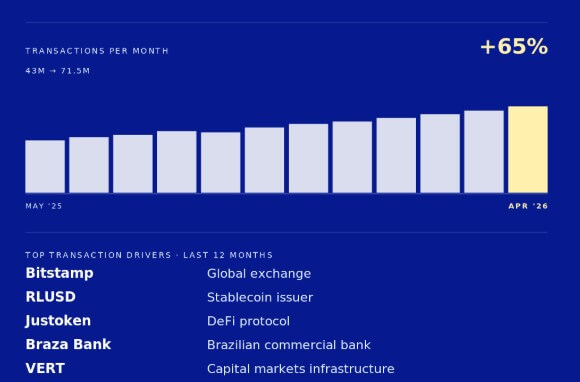
According to the firm, these activities were driven by Bitstamp, Ripple’s RLUSD stablecoin, Justoken, Braza Bank, and VERT.
It stated:
“Speculative volume on a blockchain comes in bursts. Real utility looks different. Steady. Programmatic. Tied to real businesses moving real money.”
What’s next for the XRP price?
Considering the above, XRP’s near-term trajectory ultimately hinges on whether spot demand can translate this institutional progress into sustained buying pressure.
If ETF inflows persist, the spot cumulative volume delta improves, and the taker buy-sell ratio remains above parity, the heavily bearish derivatives positioning could backfire, triggering a wave of forced buying.
In that scenario, negative funding and climbing open interest would act as rocket fuel for an XRP rally toward the $1.50 to $1.60 range.
Conversely, if spot demand falters, that same leverage leaves XRP highly vulnerable to a sharp reversal.
A market propped up by rising open interest without underlying spot support can unwind violently, particularly when traders are deeply divided near a contested price range.
This dynamic makes the current market setup less about a single upcoming catalyst and more about a fundamental regime change.
Ultimately, XRP is transitioning from an asset dominated by offshore exchange speculation to one defined by ETFs, institutional credit, ledger utility, and tokenized-asset infrastructure.
Credit: Source link